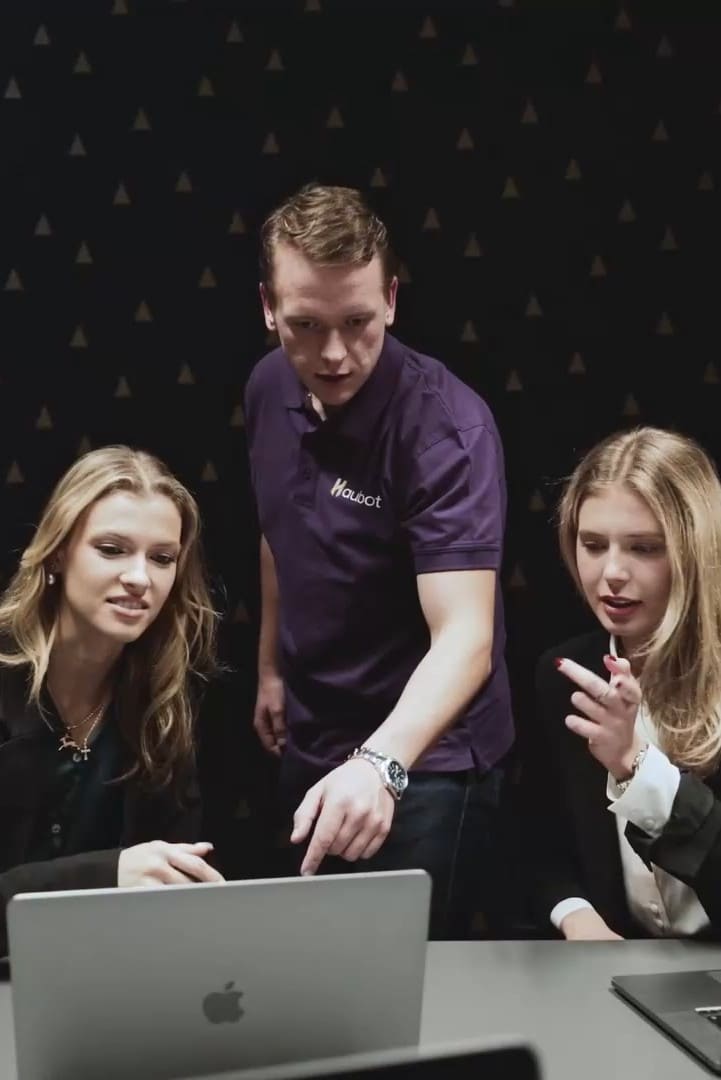
Not a reaction to market trends — a foundation. We are building the systems, the network and the standards that let businesses trade complex assets across borders with confidence.
Cross-border B2B trade has grown more complex, more international and more demanding — while much of it still runs on email threads, screenshots and informal promises. The gap between how trade actually works and how it should work is the problem Haubot exists to close.
Haubot is building the systems that make trade more transparent, more connected and more accountable — across every sector it serves.
A listing is a starting point, not a transaction. The future Haubot is building treats discovery as the first step in a connected process — where business profiles, verified providers, auctions, direct inquiries, inspection, financing support, logistics coordination and document handling work as one environment rather than a chain of disconnected tools.
That environment is multi-sector by design. Aviation, marine, energy, oil and gas, industrial automation, agriculture, transport and construction each trade differently — and the infrastructure has to adapt to the asset and the sector, not force every deal through one template.
The alternative — a fragmented broker chain where information, trust and responsibility are scattered across intermediaries — is exactly what Haubot is built to replace with a coordinated digital trade environment.
Trust should not be a slogan. It should be designed into the product.
On Haubot, trust is structural. It is assembled from working components — each one making a transaction more legible to the people who have to rely on it.
Counterparties are not anonymous handles. Business profiles carry identity, history and standing, so a buyer or seller knows who is actually on the other side of a transaction.
A deal moves through defined stages rather than an improvised exchange of messages. Communication stays on-platform and the transaction history is auditable — so a deal can be understood after the fact, not only during it.
Condition can be evidenced rather than described. Independent inspection records attach to the asset and the deal through Haubot Inspect, where the parties choose to use it.
Documentation is the part of a transaction most often disputed later. UnitVault preserves the document trail — disclosure packages and verification records — so what was shared, and when, can be established.
Not every detail of a deal belongs in public. Sensitive transaction information can be shared with a defined group on defined terms, rather than exposed openly or buried in private email.
For deals that need it, SecureTrade structures how value moves — against agreed, documented milestones rather than informal trust. It is an opt-in layer, not a guarantee of outcome.
The visible part of trade is the listing and the handshake. The part that decides whether a deal completes is everything underneath: verification, documentation, inspection, financing, logistics and a structure both sides can rely on.
Haubot's long-term work is in that underneath. Not a flashier marketplace — a more dependable one, where the systems that carry a transaction are designed, not improvised.
That is the difference between reacting to how trade is done and building how it should be.
Global trade cannot be run from a spreadsheet. A unified platform is only useful if it respects the realities of the places it operates in — and those realities are not the same in any two regions.
Haubot's direction is a unified digital platform with locally aware execution — global structure, local intelligence.
The point of data on Haubot is not to replace judgement — it is to give expertise better material to work with. Practical intelligence, applied where it removes real friction.
Technology should support human expertise, not stand in for it.
The future of trade is not fully automated. Judgement, inspection and coordination are human work — Haubot's role is to make that expertise more scalable, more visible and more connected.
Speed matters in trade — but speed without accountability is just risk moving faster. Haubot's growth is built to stay answerable for how transactions run on the platform, not only for how many.
The fragmented broker chain — where information, trust and responsibility scatter across intermediaries — is the failure mode Haubot is built to replace. Workflows are traceable by design, so a transaction can be reconstructed and understood, not just remembered.
Cross-border trade carries obligations that differ by jurisdiction, sector and counterparty. Haubot treats compliance awareness as part of the workflow — and handles regulated and sensitive sectors, including government and defense-related assets, with the care and limits they require.
A failed shipment or an unclear handover is not only a cost — it is a trust failure. Structured documentation, inspection and logistics coordination exist to narrow the gap between what was agreed and what actually happens.
Responsible growth means relationships that compound, not opportunities that burn. That shapes how providers are vetted, how partners are chosen, and how carbon-aware logistics is approached where it is genuinely feasible.
These are the areas Haubot is actively building. The work is underway, and the direction is consistent — every layer below makes a transaction easier to trust and easier to complete.
We are developing more precise search, categorisation and matching, so the right asset reaches the right buyer with less noise in between.
We are expanding the depth of business profiles, so a counterparty's identity, history and standing are part of the decision — not a guess.
We are building toward a richer directory of inspectors, logistics companies, suppliers and specialists, discoverable where a transaction actually needs them.
We are extending structured, milestone-based transaction flow, so funds and obligations move against agreed conditions rather than informal trust.
We are deepening hash-verified document handling and disclosure records, so what was shared — and which version — can be established later.
We are connecting independent inspection more tightly into the transaction, so condition is evidence rather than description.
Our direction includes better coordination of transport, documentation and milestones, with visibility from origin to handover.
We are expanding financing coordination — preparing finance-ready cases and working with independent financial partners.
We are building controlled deal rooms and private trading environments, for transactions that should be shared with a defined group rather than published openly.
We are developing integrations that let partner and internal systems connect to Haubot rather than work around it.
We are expanding language and regional coverage, so the platform meets companies in the markets and languages they actually operate in.
We are building toward timely, relevant signals — what changed, what needs attention, what is worth knowing — without the noise.
Haubot's future is multi-sector. Each field carries its own kind of trade complexity — and that is precisely where structured infrastructure earns its place.
Aviation assets carry deep paper trails — records, identity and ownership history — and a single unit can cross several jurisdictions before it changes hands. The value sits as much in the documentation as in the airframe or the equipment itself. Structured infrastructure keeps that trail intact and reviewable across borders.
Vessels and offshore assets trade on registration, insurance and condition as much as on price, and physical inspection access is rarely straightforward. Specialized equipment often has no clean comparable to price against. A structured environment turns those uncertainties into documented, reviewable facts.
Generators, turbines and power infrastructure are tied to project economics, site location and intended operational use — the asset cannot be assessed in isolation from the project around it. Documentation has to keep pace with all of it. Coordinated infrastructure keeps the asset, its context and the paperwork aligned.
Field, processing and support equipment trades under documentation and compliance demands that few other sectors match. Counterparty, end-use and jurisdiction all carry weight in every deal. Structured workflows make those checks part of the transaction rather than an afterthought to it.
Production lines and automation assets rarely move as a single box — they involve staged delivery, installation and hard questions of compatibility with existing systems. A transaction often has to be sequenced, not just signed. Infrastructure that coordinates those stages is the difference between a working line and an expensive mismatch.
High-utilisation fleets and transport assets are in near-constant cross-border movement, and their identity and condition have to travel with them. Wear, hours and history change quickly. A structured record keeps the asset's real state legible wherever it is.
Seasonal, high-use machinery is bought and sold on a precise reading of wear, hours and condition — a single season of heavy use can change an asset materially. Buyers are often acquiring against a narrow operational window. Evidence-based condition records make that decision defensible.
A large, liquid market — and one sector among many on Haubot, not the centre of it. Here the deciding factors are usually verification and logistics: confirming the machine is what it claims to be, and getting it to site cleanly. Structured infrastructure is what keeps a straightforward-looking deal from going sideways.
Institutional and government-related assets move through procurement and disposal structures with their own rules, eligibility checks and documentation standards. These transactions demand careful handling and are subject to compliance and applicable requirements. Haubot's role is to bring structure and traceability to that process — responsibly, and within those limits.
Haubot's direction is not a manifesto for its own sake. It is being built through systems, people, partnerships, data, accountability and real transaction experience — one layer at a time.
If your business is looking for more than a place to post a listing — for an environment built to carry a transaction from interest to execution — the future Haubot is building is for you.
Buyers, sellers, suppliers, service providers, logistics partners, inspectors and strategic partners all have a place in it.
Whether you are sourcing, selling, providing a service or building a partnership, there is a way to be part of what Haubot is building. Start the conversation.
Tell us who you are and what you are looking to do. A short message is enough to start — the more context you give, the more useful our first reply can be.